Palo Alto's current firewall families
October 24, 2026 · Casey’s Corner
Palo Alto Networks offers hardware firewalls for very different jobs: protecting a small branch, securing an industrial site, inspecting traffic at a campus edge, or defending a large data center. The right platform depends on where it will operate, which security services it must run, and how much room the network needs to grow.
The stack below uses a representative model for each entry. The descriptions follow the picture from top to bottom. The modular PA-5450 is discussed separately from the fixed PA-5400 appliances, although Palo Alto Networks includes it in the PA-5400 Series.
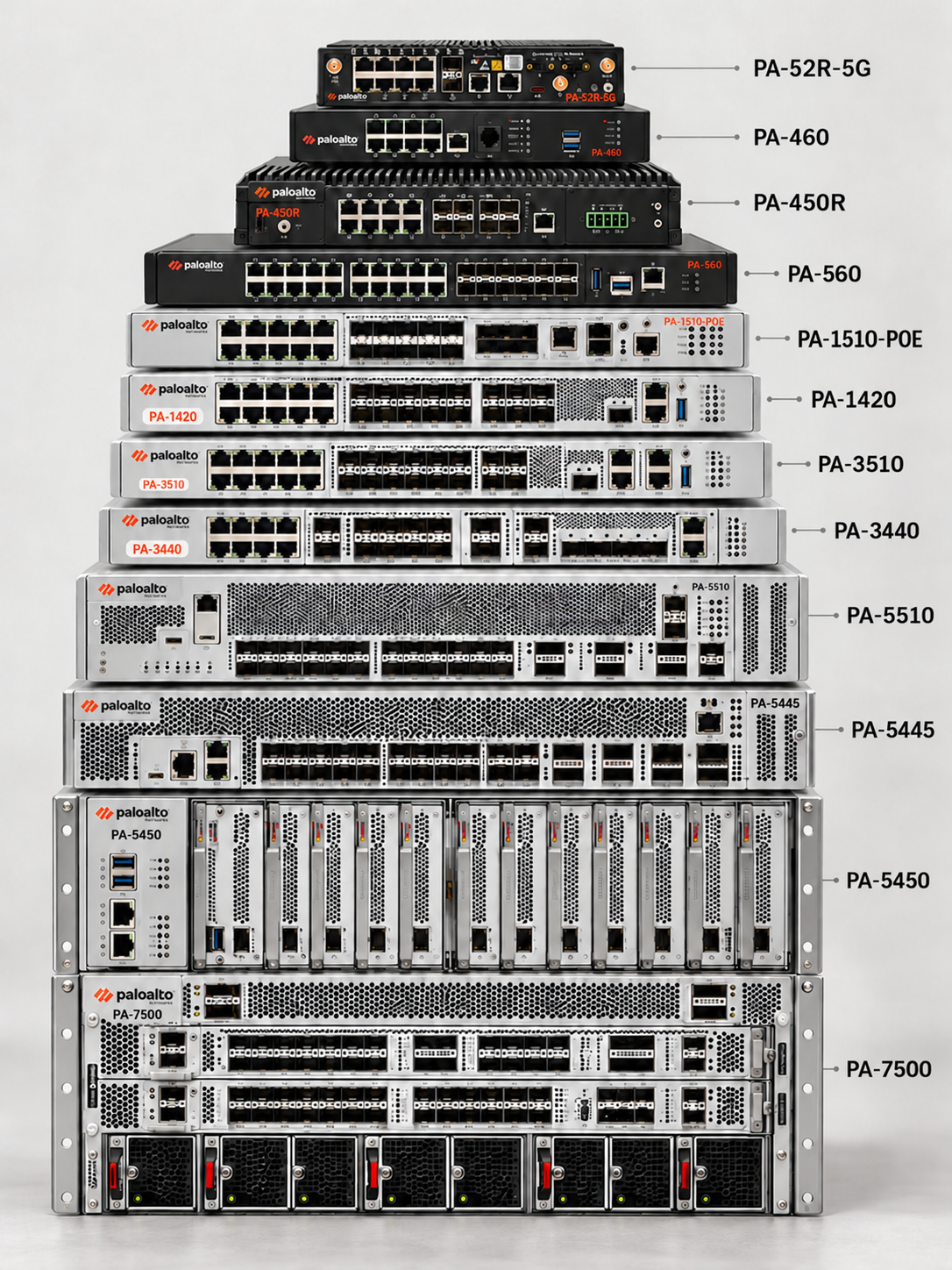
AI-generated illustration; not to scale. See the linked hardware guides for exact chassis and port layouts.
Lifecycle dates checked October 25, 2026. EOS = End of Sale; EOSS = End of Standard Support for the last supported PAN-OS release; EOL = hardware End of Life. EOSS does not end all support: the designated final PAN-OS release continues in extended support until hardware EOL, subject to a valid support contract. PAN-OS support lifecycle.
PA-50R Series — rugged security for demanding locations
Shown: PA-52R-5G. This family brings next-generation firewall protection to industrial sites, transportation systems, and mobile deployments where temperature, vibration, and power conditions differ from an office. The rugged design supports flexible DC power, with 5G, GPS, and PoE options varying by model. It is a useful starting point when environmental requirements matter as much as traffic capacity. PA-50R hardware guide.
PA-400 Series — compact branch and small-office protection
Shown: PA-460. The PA-400 family serves smaller organizations and distributed branches with PAN-OS application, user, and content controls in compact appliances. It supports zero-touch provisioning and high availability, while selected models add cellular connectivity or PoE. These options differ across the family; the PA-460 should not be assumed to include every feature available on another PA-400 model. PA-400 hardware guide.
Announced lifecycle dates
- EOS: March 22, 2027.
- EOSS — PA-410 and PA-415: August 28, 2028 (PAN-OS 12.1).
- EOSS — PA-440, PA-445, PA-450, PA-455 and PA-460: July 30, 2029 (PAN-OS 12.2).
- EOL: March 21, 2032 for all models listed above.
The announcement covers these non-rugged, non-cellular models; it does not cover PA-400R or cellular variants. Recommended replacement: PA-500 Series. Official lifecycle dates.
PA-400R Series — an established rugged branch platform
Shown: PA-450R. The PA-400R family is designed for locations with varying temperature and humidity, extending firewall controls beyond conventional office environments. Model choices include wired and cellular variants, with deployment options suited to industrial installations. High availability and zero-touch provisioning help organizations manage remote sites consistently. Choose the exact model and mounting arrangement for the environment; the pictured PA-450R is a wired model. PA-400R hardware guide.
PA-500 Series — the newer compact branch family
Shown: PA-560. The current PA-500 Series targets small organizations and branch offices, with a range of capacity and connectivity options. Zero-touch provisioning supports repeatable rollouts, and high availability supports resilient deployments. Selected models offer PoE or 5G, so a branch can choose features that fit its local devices and uplinks. This is the newer series represented by the PA-560, not the retired legacy PA-500 appliance. PA-500 hardware guide.
PA-1500 Series — branch security with switching and PoE
Shown: PA-1510-POE. The PA-1500 family combines enterprise branch firewall functions with a high density of copper and fiber connections. Multigigabit copper, 10G and 25G fiber options, and PoE help connect local endpoints and access equipment. Integrated switching can simplify some branch designs, while redundant power options support availability. Check the model’s power budget and interface requirements against the devices it will serve. PA-1500 hardware guide.
PA-1400 Series — distributed enterprise connectivity
Shown: PA-1420. The PA-1410 and PA-1420 are designed for distributed enterprise branches and data-center deployments. The family combines multigigabit networking, PoE capability, redundant power, and hardware-based secure boot. It fits organizations that need more connectivity and resilience than a smaller branch appliance provides. Selection should consider the expected inspection workload and the mix of copper and fiber links. PA-1400 hardware guide.
PA-3500 Series — newer platforms for larger sites
Shown: PA-3510. The PA-3500 family addresses larger branches, enterprise networks, and data centers. It provides dedicated processing resources for networking, security, and management, together with local storage and redundant AC or DC power options. These appliances are candidates for campus and perimeter designs that need higher capacity and faster connectivity while retaining a fixed appliance form factor. PA-3500 hardware guide.
PA-3400 Series — data-center and internet-gateway appliances
Shown: PA-3440. The PA-3410, PA-3420, PA-3430, and PA-3440 serve data-center and internet-gateway deployments with different capacity levels. The family includes multigigabit interfaces, power redundancy, and hardware-based secure boot. It is suited to organizations that need a rack-mounted security platform for substantial traffic flows. Compare the specific model’s inspected traffic capacity and port mix with the design’s requirements. PA-3400 hardware guide.
PA-5500 Series — high-capacity fixed appliances
Shown: PA-5510. The PA-5500 family serves large enterprises, data centers, and internet gateways. Dedicated processing resources separate networking, security inspection, and management workloads, while redundant AC or DC power supports resilient installations. Models span different capacity and interface requirements. This family is worth evaluating when a large site needs substantial inspection capacity in a fixed appliance rather than a modular chassis. PA-5500 hardware guide.
PA-5400 Series — fixed platforms for large enterprise networks
Shown: PA-5445. The fixed PA-5400 models support large-enterprise, data-center, and internet-gateway environments. They dedicate resources to networking, security, signature matching, and management so those functions can operate efficiently. Redundant power and hardware-based secure boot support dependable deployments. The PA-5445 represents the fixed appliances in this illustration; the PA-5450 uses a different, modular approach. PA-5400 hardware guide.
PA-5450 — modular capacity within the PA-5400 family
Shown: PA-5450. Unlike the fixed PA-5400 appliances, the PA-5450 uses network and data-processing cards. This architecture allows interface capacity and security-processing resources to be configured for the deployment. It was designed for demanding enterprise and data-center workloads. An announced end-of-sale date makes lifecycle planning especially relevant for new purchases; see the dated note below. PA-5450 architecture and hardware guide.
Announced lifecycle dates
- EOS: November 22, 2026.
- EOSS: July 30, 2029 (PAN-OS 12.2).
- EOL: November 21, 2031.
These dates apply to the PA-5450 and the associated components listed in the announcement, not the fixed PA-5400 appliances. Recommended replacement: PA-5500 Series. Official lifecycle dates.
PA-7500 Series — modular security at very large scale
Shown: PA-7500. The PA-7500 is a modular, multiblade platform for very large deployments. Separate management, network, data-processing, and switch-fabric cards support a scalable architecture, with hot-swappable components and AC or DC power options. It addresses environments where capacity, interface density, and operational resilience justify a chassis system. Planning must account for the selected cards, redundancy, power, cooling, and future expansion. PA-7500 hardware guide.
Choosing the right family
Start with the traffic that must be inspected, including encrypted traffic and the security services you intend to enable. Then compare interface types, high-availability requirements, environmental limits, power, and room for growth. A larger model number alone does not establish the best fit. A realistic design and proof of concept help connect the platform choice to the organization’s actual needs.
Availability and lifecycle — October 25, 2026 snapshot
No hardware EOS or EOL dates are listed in the official lifecycle table for the other current families covered in this article. Their eventual retirement dates have not been announced.
“Current” does not mean that every platform has the same remaining sales lifecycle. Palo Alto Networks lists November 22, 2026 as the PA-5450 end-of-sale date, with the PA-5500 Series as its replacement. Listed PA-400 models have an end-of-sale date of March 22, 2027, with the PA-500 Series as their replacement. End of sale is different from end of support. Confirm the exact SKU, regional availability, and lifecycle dates before ordering. Official hardware lifecycle table.